
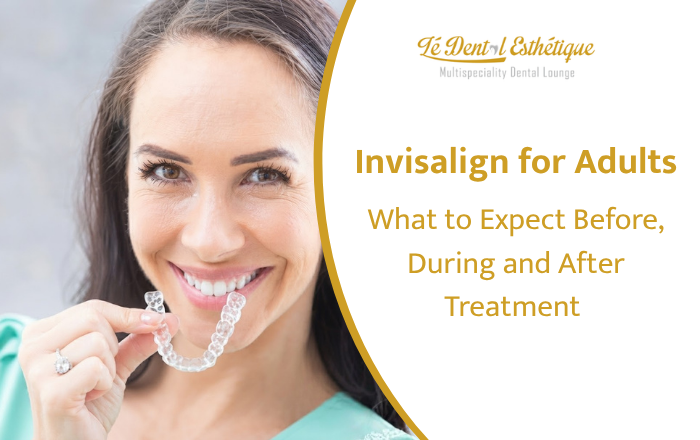
Yes, Invisalign for adults is a practical way to straighten teeth without fixed metal braces. Invisalign is a brand of clear aligners: thin, removable plastic trays made to fit your teeth that move them a little at a time. For most adults, the process has three stages: a dental check and scan before you start, wearing the aligners for about 20 to 22 hours a day during treatment, and wearing a retainer afterwards to hold the result.
If the thought of metal braces at work has held you back, here is what each stage involves.
Is Invisalign Suitable for Adults?
For many adults, it is. There is no fixed upper age limit for moving teeth, as long as the gums and the bone supporting them are healthy. The American Association of Orthodontists notes that about 1 in 3 orthodontic patients today are adults.
Clear aligners for adults are commonly used to treat:
- Crowded or overlapping teeth
- Gaps between teeth
- Mild to moderate bite problems, such as an overbite, underbite or crossbite
- Teeth that have shifted again years after childhood braces
Aligners are not right for every mouth, though. As Cleveland Clinic explains, they suit crooked or crowded teeth and some mild to moderate bite problems, while more complex cases may need fixed braces. Our guide on Invisalign vs braces covers the differences.
What Happens Before Invisalign Treatment Starts?
Your First Consultation
The dentist will examine your teeth, gums and bite, and ask what bothers you about your smile. You can expect X-rays, photographs and a digital scan or impressions of your teeth.
Treating Other Dental Problems First
Cavities, broken fillings or gum disease usually need attention before aligners are made. Gum health matters a lot in adults, because teeth move through the bone that holds them. If there is inflammation or bone loss, gum treatment may come first.
Planning How Your Teeth Will Move
Using your scan, the dentist plans how each tooth will move and how many sets of aligners you will need. Small tooth coloured bumps called attachments may be bonded to some teeth so the aligners can grip them. Occasionally, a tiny amount of enamel is polished between teeth to make room.
Aligners are made in a lab, so there is usually a gap of a few weeks between your scan and your first fitting.
What to Expect During Invisalign Treatment
The First Few Days
Your teeth will probably feel tight or slightly sore at first, and again for a day or two with each new set. This pressure usually settles within a few days. Your speech may also sound slightly different until your tongue gets used to the trays.
A few things that help:
- Choose softer foods like dal, khichdi or idli for the first couple of days
- Start a new set at bedtime so the tightest hours pass while you sleep
- Ask your dentist which painkiller is safe for you if needed
How Many Hours a Day Do You Need to Wear Invisalign?
Most adults are asked to wear their aligners for 20 to 22 hours a day. As the AAO explains, each aligner moves teeth only a fraction of a millimetre at a time, so steady wear matters. Take them out just to eat, drink anything other than plain water, and brush and floss.
Eating, Drinking and Daily Routine
- Remove aligners before meals and before tea or coffee. Hot drinks may warp the plastic, and sugary drinks can stay trapped against your teeth.
- Brush before putting them back in. If you are out, rinse well with water.
- Always use the case. Aligners wrapped in a tissue at a restaurant are easily thrown away.
- Clean them gently with a soft brush and cool water.
Weddings, office lunches and constant snacking are where most adults struggle. Grouping meals together makes the wear time easier to manage.
Review Visits
You will usually switch to a new set every one to two weeks. Review visits are often spaced every 6 to 8 weeks to check your progress.
How Long Does Invisalign Take for Adults?
It depends on how much your teeth need to move. Minor crowding may need up to about nine months, while more involved cases take longer. Wearing your aligners as advised is the biggest factor you control.
What Happens After Invisalign Treatment?
Why the Retainer Matters
Once your teeth reach their new position, the bone and gums around them need time to settle. Without a retainer, teeth tend to drift back, and adult teeth can keep shifting slowly with age. Many people start with longer daily wear and later move to night time wear, as their dentist advises.
Keeping the Result
Attachments are polished off once treatment ends. Clean your retainer daily, keep it in its case and continue regular dental visits. If a retainer cracks or stops fitting, get it replaced soon.
When Should You Contact Your Dentist During Treatment?
Contact the clinic if you notice:
- Sharp pain, or soreness lasting more than a few days
- Gums that bleed or swell
- An aligner that feels loose, cracks or gets lost
- An attachment that has come off
Frequently Asked Questions
1. Does Invisalign hurt for adults?
Most adults feel pressure or mild soreness rather than real pain. It is usually strongest for the first day or two of each new set and then settles. Soft foods and starting new aligners at bedtime help. If pain is sharp or lasts more than a few days, contact your dentist.
2. Is it too late to get Invisalign at 40 or 50?
Age alone is rarely the problem. What matters more is the health of your gums, the bone supporting your teeth and any existing dental work. Teeth can be moved at any adult age if they are well supported. An examination with X-rays will show whether they suit you.
3. Can I drink tea or coffee with Invisalign on?
Take your aligners out before tea, coffee or any drink other than plain water. Hot drinks may warp the plastic, tea and coffee can stain the aligners, and sugar can sit against your teeth. Rinse or brush afterwards, then put them back in.
4. What happens if I lose or break an aligner?
Call your dentist rather than going without. Depending on your stage of treatment, you may be asked to wear your previous set or move to the next one until a replacement arrives. Several days without an aligner can let teeth shift, so act quickly.
5. Do I need to wear a retainer forever after Invisalign?
Most people need a retainer for a long time, often only at night, to stop their teeth moving back. Teeth shift naturally throughout life, so long term retainer wear is the most reliable way to protect your result. Your dentist will advise the type and how often to wear it.
Considering Clear Aligners? Start With a Proper Assessment
Invisalign for adults can work well, but the result depends on your teeth, your gum health and how consistently you wear the aligners. A careful assessment is the right first step.
Book a Consultation
If you would like to know whether clear aligner treatment is right for you, Lè Dental Esthètique in Yerawada, near Kalyani Nagar, is led by Dr. Charvee Devjee, an orthodontist (MDS in Orthodontics) with 15+ years of experience in dentistry. She can examine your teeth and discuss whether clear aligners such as Invisalign, or ceramic or metal braces, would suit your case.
Address: Unit Number 11, 1st Floor, Nyati Unitree, West Building, Opposite Gunjan Theatre, Nagar Road, Yerawada, Near Kalyani Nagar, Pune, Maharashtra 411006
Phone: 94057 62667
WhatsApp: Click here to chat on WhatsApp
Suitability and timelines vary from person to person, so please consult a qualified dentist before starting treatment.