
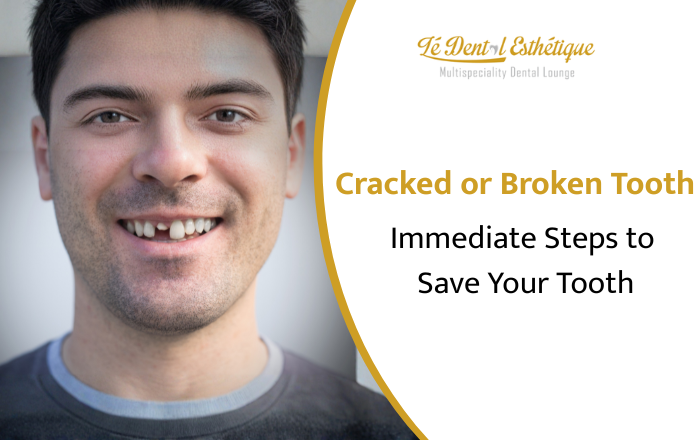
One moment you’re enjoying your favourite crunchy snack, and the next — crack. That sharp, unsettling feeling in your mouth stops you cold. If you’ve ever experienced a cracked tooth or a broken tooth, you know exactly how frightening that moment can be. Your first instinct might be to panic, but here’s the good news: if you act quickly and do the right things, there’s a strong chance your tooth can be saved.
A cracked tooth is more common than most people think. In fact, cracked teeth are one of the leading causes of tooth loss in adults. But the outcome depends almost entirely on how fast you respond. This guide walks you through every step you need to take right now — and what to expect when you get to the dentist.
What Happens When You Crack or Break a Tooth?
Your teeth are incredibly strong, but they’re not unbreakable. When a cracked or broken tooth occurs, the damage can range from a tiny surface line to a deep split that reaches the root. The tricky part? Some cracks cause immediate sharp pain, while others are silent — no pain at all — until the problem becomes serious.
There are five common types of tooth cracks:
▸ Craze lines — hairline cracks on the surface only, usually harmless
▸Fractured cusp — a piece of the chewing surface breaks off
▸Cracked tooth — a crack that runs from the top of the tooth downward
▸Split tooth — the tooth splits into two distinct segments
▸Vertical root fracture — starts at the root and moves upward, often going unnoticed the longest
Knowing which type you’re dealing with helps your dentist choose the right broken tooth repair approach.
7 Warning Signs of a Cracked Tooth You Shouldn’t Ignore
Not every cracked tooth announces itself with dramatic pain. Watch for these signs:
- Sharp pain when biting or chewing — especially when you release the bite
- Sudden sensitivity to hot, cold, or sweet foods
- Pain that comes and goes with no clear pattern
- Swelling or tenderness around one tooth
- A visible line, chip, or rough edge you can feel with your tongue
- Difficulty pinpointing exactly where the pain is coming from
- A feeling that something is “off” when your teeth come together
If you notice even two or three of these, you’re likely dealing with a cracked tooth that needs attention soon.
7 Immediate Steps to Save Your Cracked or Broken Tooth
This is the most important section. What you do in the first few hours after a broken tooth emergency can make or break your chances of keeping it.
Step 1 — Stay calm and take a look. Use a mirror and good lighting to assess the damage. Avoid poking it repeatedly with your tongue.
Step 2 — Rinse with warm salt water. This is your safest first move. Salt water is gentle, naturally antibacterial, and helps reduce irritation around the cracked tooth.
Step 3 — Save any broken pieces. If a chunk has broken off, don’t throw it away. Place it in a small container with milk or saline solution — not tap water. Your dentist may be able to use it.
Step 4 — Manage the pain carefully. Over-the-counter pain relievers like ibuprofen are fine. Do not place aspirin directly on the gum — this is a common mistake that can burn the tissue and make things worse.
Step 5 — Cover the tooth temporarily. Dental wax or a small piece of sugar-free gum can act as a protective barrier over a broken tooth until you reach the dentist. Avoid hard, chewy, or sticky foods entirely.
Step 6 — Apply a cold compress. Hold it against your cheek for 15–20 minutes at a time to reduce swelling. Never apply ice directly to the skin.
Step 7 — Call your dentist immediately. This is non-negotiable. Waiting even 24–48 hours can allow bacteria to reach the inner layers of a cracked tooth, turning a manageable situation into a root canal — or worse, an extraction.
Treatment Options Your Dentist May Recommend
Once you’re in the chair, your dentist will assess the type and depth of the cracked tooth and recommend one of the following:
▸ Dental bonding — for minor cracks, a tooth-coloured resin is applied to restore shape
▸Dental crown — caps the damaged tooth and protects it from further splitting
▸Root canal — needed when the crack has reached the nerve inside the tooth
▸Veneers — a good option when a broken tooth affects the front of your smile
▸ Extraction — only when the crack extends too deep into the root to be saved
The earlier you come in, the more options are on the table.
Don’t Wait — Visit Lè Dental Esthètique in Yerawada Today
A cracked tooth won’t fix itself. Every hour you wait increases the risk of deeper damage, infection, or permanent tooth loss. If you or someone you love is dealing with a broken tooth or cracked tooth treatment need in Yerawada, there’s one place to go.
At Lè Dental Esthètique Dental Clinic, Dr. Charvee Devjee brings a calm, careful, and patient-focused approach to cracked tooth treatment. Whether it’s a small chip or a serious break, the clinic is equipped to diagnose the damage accurately and help you keep your natural tooth whenever possible.
Don’t ignore that crack. Book your consultation with Dr. Charvee Devjee at Lè Dental Esthètique, Yerawada — because the sooner you act, the better your smile’s future looks.
Name – Le Dental Esthetique – Dr. Charvee Devjee
Address: Unit Number 11, 1st Floor, Nyati Unitree, West Building, Opposite Gunjan Theatre, Nagar Road, Yerawada, Near, Kalyani Nagar, Pune, Maharashtra 411006
Phone: 94057 62667
Frequently Asked Questions About Cracked Teeth
Q1. Can a cracked tooth heal on its own?
No. Unlike bones, teeth cannot regenerate or self-repair. A cracked tooth will only worsen over time without treatment.
Q2. Is a cracked tooth always painful?
Not always. Some cracked teeth cause no pain at all, which is why regular dental check-ups are so important.
Q3. How long can you leave a cracked tooth untreated?
Not long. Within days to weeks, bacteria can enter the crack and cause infection. Broken tooth repair should never be delayed.
Q4. What foods should I avoid with a cracked tooth?
Avoid hard foods (ice, nuts, hard candy), sticky foods, and very hot or cold drinks until your dentist has treated the cracked tooth.
Have questions? We’re just a message away! Contact us on WhatsApp — Click Here to Chat with Us